For over a century, the traditional classroom has looked almost the same: a teacher standing in front of rows of students, delivering the same lesson to everyone. Today, that model is evolving. AI is helping create classrooms that are more personalized, interactive, and efficient than ever before.
Welcome to the Intelligence Age of Education.
From Passive Learning to Active Learning
One of AI’s greatest contributions to education is turning students from passive listeners into active participants.
Instead of simply receiving information, students can now interact with intelligent learning assistants that explain concepts in different ways until understanding is achieved.
Platforms such as:
- Khanmigo
- Duolingo Max
- Carnegie Learning
allow learners to ask questions, receive instant explanations, complete personalized exercises, and progress at their own pace.
Unlike traditional classrooms where everyone moves together, AI-powered learning follows the principle of mastery learning. Students only move forward after demonstrating genuine understanding.
This means every learner effectively has access to a personal tutor available 24 hours a day.
AI Gives Teachers More Time to Teach
Contrary to popular belief, AI is not replacing teachers.
It is removing repetitive administrative work so teachers can focus on what matters most—teaching.
Studies have shown that teachers spend countless hours each week on activities such as:
- Grading assignments
- Creating lesson plans
- Preparing worksheets
- Writing student reports
- Administrative paperwork
Generative AI can complete many of these tasks within minutes.
Imagine a teacher generating:
- Multiple versions of the same worksheet for different ability levels
- Instant grammar and spelling feedback on essays
- Individualized learning plans for students with special educational needs
Instead of spending hours on paperwork, teachers gain more time for mentoring, classroom discussions, creativity, and personal interaction.
- Technology handles the routine.
- Teachers handle the human connection.
Ending the “One Lesson for Everyone” Approach
Every classroom contains students with different learning abilities.
Some learn quickly.
Others need more explanation.
Traditional teaching often struggles to meet everyone’s needs simultaneously.
Artificial Intelligence changes that.
Imagine a history lesson on the Roman Empire.
Instead of every student receiving identical material:
Student A (Needs Extra Support)
Receives:
- Illustrated explanations
- Simplified vocabulary
- Short learning videos
Student B (Average Progress)
Receives:
- Standard textbook material
- Interactive quizzes
- Timeline activities
Student C (Advanced Learner)
Receives challenging questions like:
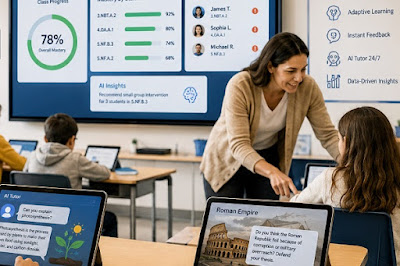
“Did corruption or military expansion contribute more to the fall of the Roman Republic? Defend your position.”
Every learner is challenged at the appropriate level.
This is personalized education at scale.
Instant Feedback Accelerates Learning
Traditional education often suffers from delayed feedback.
A student submits an assignment.
Days later, it is graded.
By then, the learning opportunity may have faded.
AI shortens this feedback loop to seconds.
For example, while writing an essay, an AI assistant can instantly:
- Highlight weak arguments
- Suggest stronger evidence
- Detect logical fallacies
- Improve sentence structure
- Recommend better organization
Students revise immediately rather than waiting for corrections days later.
📖 Related Reads
Learning becomes continuous rather than delayed.
New Skills for the AI Era
As Artificial Intelligence becomes part of everyday education, the skills students need are also changing.
Memorizing facts is becoming less important than knowing:
- How to ask effective questions
- How to evaluate AI-generated information
- How to verify facts
- How to think critically
- How to solve complex problems
A new digital literacy is emerging.
Students are learning prompt engineering—the ability to write clear instructions that produce useful AI responses.
Equally important is verification.
Because AI can sometimes generate inaccurate information, students must learn to fact-check, compare sources, and apply sound judgment.
The classroom is shifting from teaching answers to teaching thinking.
Challenges That Cannot Be Ignored
While AI offers tremendous opportunities, it also raises important concerns.
The Digital Divide
Not every student has access to:
- Reliable internet
- Modern computers
- AI learning tools
Without equal access, educational inequality could widen rather than shrink.
Governments and educational institutions must work to ensure AI benefits all learners—not just those with greater resources.

Academic Integrity
AI has changed homework forever.
Students can now generate essays, solve equations, and answer questions in seconds.
Rather than banning AI, many schools are redesigning assessment methods by emphasizing:
- Project-based learning
- Oral presentations
- Classroom discussions
- Practical demonstrations
- Critical thinking exercises
Some educators even ask students to submit their AI prompts and revision history as part of the learning process.
The focus shifts from simply producing an answer to demonstrating genuine understanding.
The Classroom of Tomorrow
Walk into an AI-powered classroom in the coming years, and the experience may look very different.
You might see:
- Students learning foreign languages through AI conversation partners.
- Personalized dashboards showing each learner’s progress in real time.
- Teachers working with small groups while AI supports independent learners.
- Interactive simulations replacing static textbook diagrams.
- Real-time intervention for students who need additional help.
The physical classroom may still contain desks, whiteboards, and teachers.
But the learning experience will be far more flexible, personalized, and intelligent.
Final Thoughts
Artificial Intelligence is not redefining education to replace teachers or remove the human element from learning.
Instead, it is helping schools fulfill a promise educators have always believed in:
Every student learns differently.
By providing personalized instruction, instant feedback, adaptive learning paths, and greater support for teachers, AI is making education more inclusive, engaging, and effective than ever before.
The classroom of the future is not about robots teaching children.
It is about empowering teachers, supporting learners, and ensuring every student has the opportunity to reach their full potential.
As AI continues to evolve, one thing is clear:
The future of education has already begun.
What Do You Think?
Do you believe Artificial Intelligence will improve education or create new challenges for schools?
Share your thoughts in the comments below, and don’t forget to subscribe to TechFalz.com for the latest updates on technology, education, innovation, business, and digital transformation.