English Studies is a core subject in Junior Secondary School that equips students with essential communication, reading, writing, listening, and speaking skills.
The JSS 1 English Studies Scheme of Work is carefully designed to help learners develop confidence in using the English language while introducing them to literature, composition writing, grammar, and oral English.
JSS 1 English Studies Scheme of Work
First Term
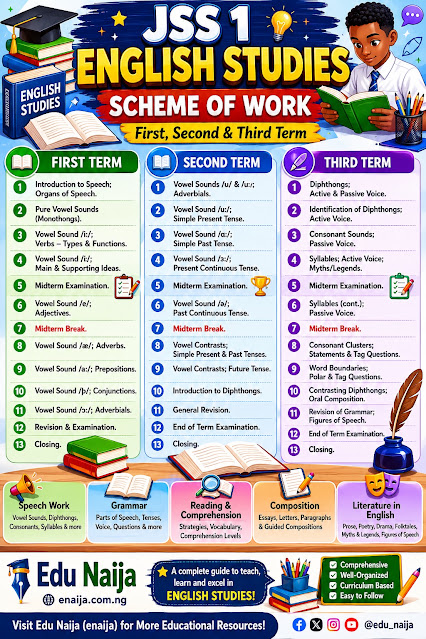
In Week 1, students will be introduced to speech work and the organs of speech. In Grammar, they will learn about nouns, their meanings, and types. Reading and comprehension lessons will focus on the family and the introduction to language skills (Listening, Speaking, Reading, and Writing). Composition lessons will introduce the meaning and types of composition, while Literature in English will focus on the meaning of literature.
In Week 2, students will study pure vowel sounds (monothongs). Grammar lessons will cover pronouns, their meanings, identification, and types. Reading and comprehension will focus on reading strategies. Composition lessons will examine the elements of composition, including introduction, body, and conclusion. Literature lessons will cover the features and types of literature such as oral literature, historical literature, dance drama, and miming.
In Week 3, students will learn the vowel sound /i:/. Grammar lessons will focus on verbs, their definitions, identification, and types. Reading activities will introduce the SPQ3R reading technique and vocabulary related to family members. Composition lessons will continue with the elements of composition, while Literature in English will focus on the functions of literature and an introduction to prose.
In Week 4, students will study the vowel sound /i/. Grammar lessons will continue with verbs and their functions. Reading comprehension will focus on identifying main and supporting ideas, while vocabulary development will center on school subjects. Composition lessons will explain the differences between descriptive and narrative essays. Literature lessons will cover the elements of prose and types of oral literature.
Week 5 will be devoted to Midterm Examinations.
In Week 6, students will learn the vowel sound /e/. Grammar lessons will introduce adjectives and the comparison of adjectives. Reading activities will focus on distinguishing main ideas from supporting ideas. Composition lessons will cover paragraph writing with proper organization, while Literature in English will introduce drama, its types, elements, characterization, and themes.
Week 7 will be observed as Midterm Break.
In Week 8, students will study the vowel sound /æ/. Grammar lessons will focus on adverbs, their identification, and types. Reading activities will involve answering specific questions from passages. Composition lessons will cover a descriptive essay on a market place. Literature lessons will continue the study of drama, characterization, and themes.
In Week 9, students will learn the vowel sound /a:/. Grammar lessons will focus on prepositions and their functions. Reading activities will involve applying the SPQ3R technique to passages. Composition lessons will introduce letter writing and its types. Literature lessons will cover folktales and the plot and setting of recommended drama texts.
In Week 10, students will study the consonant sound /p/. Grammar lessons will focus on conjunctions and their functions. Reading activities will involve asking comprehension questions that address all levels of understanding. Composition lessons will focus on the features of informal letters. Literature lessons will introduce figures of speech such as simile, metaphor, and irony.
In Week 11, students will study the vowel sound /ɔ:/. Grammar lessons will focus on adverbials, their features, functions, and types. Reading activities will involve asking questions that elicit personal opinions. Composition lessons will continue with informal letter writing, while Literature lessons will further explore figures of speech and recommended drama texts.
Week 12 will be dedicated to revision, review of prescribed texts, informal letter writing practice, and examination preparation.
Week 13 will be for closing activities and end-of-term procedures.
JSS 1 English Studies Scheme of Work
Second Term
In Week 1, students will study the vowel sounds /u/ and /u:/. Grammar lessons will focus on adverbials of frequency and manner. Reading comprehension activities will involve drawing conclusions from passages. Composition lessons will introduce formal letter writing, while Literature in English will focus on African folktales and prescribed prose texts.
In Week 2, students will continue studying the vowel sound /u:/. Grammar lessons will focus on the simple present tense. Reading activities will involve projection questions and vocabulary related to the library. Composition lessons will involve writing formal letters to school authorities. Literature lessons will introduce poetry and its features.
In Week 3, students will learn the vowel sound /ɑ:/. Grammar lessons will focus on the simple past tense. Reading activities will involve recall questions and vocabulary related to marriage. Composition lessons will focus on guided composition, while Literature lessons will examine different types of poetry and the differences between oral and written poetry.
In Week 4, students will study the vowel sound /ɜ:/. Grammar lessons will focus on the present continuous tense. Reading activities will help students identify the author’s mood and emotions. Composition lessons will cover narrative essay writing. Literature lessons will focus on the features of drama and their identification in texts.
Week 5 will be devoted to Midterm Examinations.
In Week 6, students will study the vowel sound /ə/. Grammar lessons will focus on the past continuous tense. Reading comprehension activities will help students identify the author’s attitude. Composition lessons will cover argumentative essays, while Literature lessons will continue with the study of prescribed prose texts.
Week 7 will be observed as Midterm Break.
In Week 8, students will learn vowel contrasts such as /ɒ/ and /ɔ:/ as well as /a:/ and /æ/. Grammar lessons will involve sentence construction using simple present and simple past tenses. Reading activities will focus on identifying overall impressions from an author’s style. Composition lessons will cover expository essays, while Literature lessons will compare myths and legends.
📖 Related Reads
In Week 9, students will study vowel contrasts such as /e/ and /ɜ:/. Grammar lessons will focus on the future tense. Reading activities will involve interpreting diagrams, maps, and sketches. Composition lessons will continue with argumentative essay writing. Literature lessons will examine the features of myths and legends.
In Week 10, students will be introduced to diphthongs. Grammar lessons will involve sentence construction using the simple past tense. Reading activities will focus on understanding diagrams and maps. Composition lessons will cover guided composition on cultural festivals, while Literature lessons will involve dramatization and review of prescribed texts.
Week 11 will be dedicated to general revision.
Week 12 will be for end-of-term examinations.
Week 13 will be for closing activities.
JSS 1 English Studies Scheme of Work
Third Term
In Week 1, students will be introduced to diphthongs such as /ei/, /oʊ/, /aʊ/, /iə/, /eə/, /ɔi/, /ai/, and /ʊə/. Grammar lessons will introduce active and passive voice. Reading activities will focus on spatial descriptions and air transport vocabulary. Composition lessons will introduce expository essay writing, while Literature lessons will examine themes and characterization in prescribed prose texts.
In Week 2, students will learn to identify diphthongs in words. Grammar lessons will focus on active voice. Reading activities will cover introductions and conclusions in passages, while vocabulary lessons will focus on fishing-related words. Composition lessons will continue with the elements of writing. Literature lessons will examine plot and setting in prescribed prose texts.
In Week 3, students will be introduced to consonant sounds. Grammar lessons will focus on passive voice. Reading activities will involve identifying keywords and directions in passages. Composition lessons will cover expository essays on contemporary issues, while Literature lessons will focus on language use in poetry.
In Week 4, students will study syllables in words of two, three, and four syllables. Grammar lessons will provide practice on active voice. Reading activities will focus on spatial descriptions and vocabulary development. Composition lessons will cover argumentative essay writing, while Literature lessons will identify moral lessons in myths and legends.
Week 5 will be devoted to Midterm Examinations.
In Week 6, students will continue studying syllables. Grammar lessons will focus on passive voice exercises. Reading comprehension activities will involve practice passages and cooking-related vocabulary. Composition lessons will cover argumentative essays, while Literature lessons will focus on figures of speech in poetry.
Week 7 will be observed as Midterm Break.
In Week 8, students will study consonant clusters. Grammar lessons will focus on statements and tag questions. Reading activities will involve identifying topic sentences and teaching-related vocabulary. Composition lessons will compare argumentative and expository essays. Literature lessons will involve writing short plays or stories.
In Week 9, students will learn about word boundaries and linking sounds. Grammar lessons will focus on differentiating polar and tag questions. Reading activities will involve spelling drills and comprehension practice. Composition lessons will cover expository essays, while Literature lessons will focus on the use of similes and metaphors.
In Week 10, students will study contrasting diphthongs. Grammar lessons will focus on exercises involving adverbials. Reading activities will continue with comprehension and spelling drills. Composition lessons will involve oral composition on school rules. Literature lessons will include dramatization and transforming similes into metaphors and vice versa.
In Week 11, students will study contrasting diphthongs such as /ʊə/ and /oʊ/. Grammar lessons will focus on revising nouns, pronouns, verbs, and adjectives. Reading activities will focus on evaluation skills. Composition lessons will revise all essay types, while Literature lessons will introduce figures of speech such as euphemism and pun.
Week 12 will be devoted to end-of-term examinations.
Week 13 will be for closing activities and the conclusion of the academic session.
Conclusion
The JSS 1 English Studies Scheme of Work provides students with a strong foundation in communication, grammar, reading comprehension, composition writing, speech work, and literature. By the end of the academic session, learners are expected to communicate effectively, read with understanding, write clearly, and appreciate various forms of literary expression. This foundation prepares them for more advanced English language studies in higher classes and contributes to their overall academic success.