Mathematics is one of the most important subjects offered in Junior Secondary School because it helps students develop logical thinking, problem-solving abilities, and numerical skills needed in everyday life. The JSS 1 Mathematics Scheme of Work is carefully arranged to introduce students to basic mathematical concepts and gradually build their understanding throughout the academic session.
Below is what we have actually been talking about.
JSS 1 Mathematics Scheme of Work
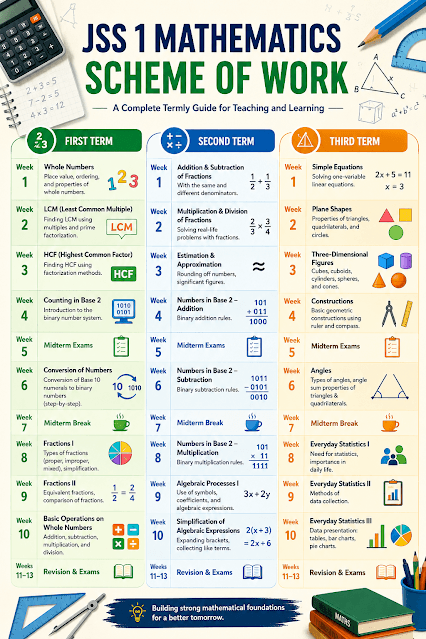
First Term
In Week 1, students will learn about whole numbers, including place value, ordering, and the properties of whole numbers.
In Week 2, students will study LCM (Least Common Multiple) by finding LCM using multiples and prime factorization methods.
In Week 3, the topic will be HCF (Highest Common Factor), where students will learn how to find HCF using factorization methods.
In Week 4, students will be introduced to counting in Base 2 and the binary number system.
Week 5 will be for Midterm Examinations.
In Week 6, students will learn the conversion of numbers, especially converting Base 10 numerals to binary numbers step-by-step.
Week 7 will be observed as Midterm Break.
In Week 8, students will study Fractions I, covering types of fractions such as proper, improper, and mixed fractions, including simplification of fractions.
In Week 9, the topic Fractions II will focus on equivalent fractions and comparison of fractions.
In Week 10, students will learn the basic operations on whole numbers, including addition, subtraction, multiplication, and division.
Weeks 11 to 13 will be dedicated to revision and examinations.
Second Term
In Week 1, students will learn addition and subtraction of fractions with the same and different denominators.
In Week 2, students will study multiplication and division of fractions and solve real-life problems involving fractions.
In Week 3, the topic will be estimation and approximation, including rounding off numbers and significant figures.
In Week 4, students will learn numbers in Base 2 with emphasis on binary addition rules.
Week 5 will be for Midterm Examinations.
In Week 6, students will continue studying numbers in Base 2, focusing on binary subtraction rules.
📖 Related Reads
Week 7 will be observed as Midterm Break.
In Week 8, students will learn binary multiplication rules under numbers in Base 2.
In Week 9, students will study Algebraic Processes I, including the use of symbols, coefficients, and algebraic expressions.
In Week 10, students will learn the simplification of algebraic expressions through expanding brackets and collecting like terms.
Weeks 11 to 13 will be used for revision and examinations.
Third Term
In Week 1, students will learn simple equations involving one-variable linear equations.
In Week 2, students will study plane shapes and their properties, including triangles, quadrilaterals, and circles.
In Week 3, students will learn about three-dimensional figures such as cubes, cuboids, cylinders, spheres, and cones.
In Week 4, students will study basic geometric constructions using ruler and compass.
Week 5 will be for Midterm Examinations.
In Week 6, students will learn about angles, including types of angles and angle sum properties of triangles and quadrilaterals.
Week 7 will be observed as Midterm Break.
In Week 8, students will study Everyday Statistics I, focusing on the need for statistics and its importance in daily life.
In Week 9, students will continue with Everyday Statistics II by learning methods of data collection.
In Week 10, students will study Everyday Statistics III, covering data presentation using tables, bar charts, and pie charts.
Weeks 11 to 13 will be dedicated to revision and examinations.