Affiliate marketing is one of the simplest ways to start earning online because you do not need to create a product, manage inventory, or handle customer support. You recommend products or services to an audience, and when someone buys through your unique affiliate link, you earn a commission.
This guide explains exactly how affiliate marketing works and gives beginners a practical path from choosing a niche to earning their first commission.
What Is Affiliate Marketing?
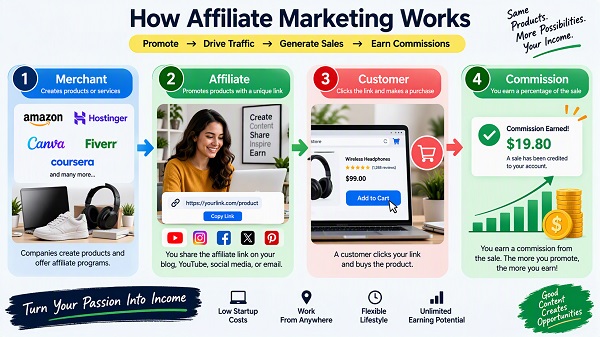
Affiliate marketing is a performance-based arrangement between a business and an affiliate. The business provides a unique tracking link, the affiliate promotes a product or service, and the business pays a commission when a qualifying action occurs—usually a sale, signup, or lead.
For example, if you write a blog post titled “Best Budget Laptops for Students” and include affiliate links to laptops you recommend, a reader who clicks one of those links and purchases the laptop may generate a commission for you. The company benefits from the sale, the reader gets a helpful recommendation, and you earn income for connecting the two.
The core process is straightforward:
-
Choose a niche and audience.
-
Join an affiliate program.
-
Receive your unique affiliate links.
-
Create helpful content around relevant products.
-
Send traffic to that content.
-
Earn commissions when readers take action.
Why Affiliate Marketing Works for Beginners
Affiliate marketing is attractive to beginners because the barrier to entry is low. You can begin with a blog, YouTube channel, TikTok account, newsletter, or social media page, and many affiliate programs are free to join.
You also do not need to be an expert in web development or business operations. Your main job is to understand a specific audience, find useful products for them, and communicate clearly why those products may help.
However, affiliate marketing is not a get-rich-quick scheme. It takes time to build trust, publish quality content, and attract consistent traffic. The people who succeed usually treat it like a real business: they choose a niche carefully, create valuable content repeatedly, and improve based on results.
Choose the Right Niche
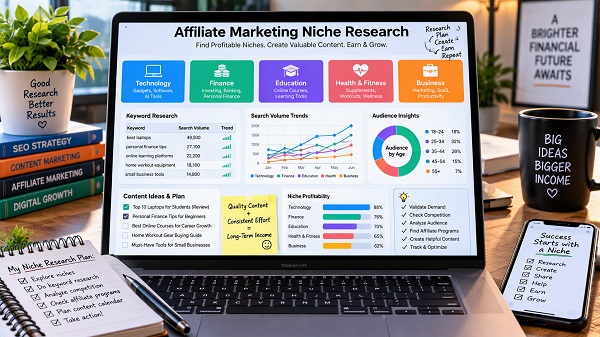
Your niche is the specific topic and audience you will serve. Instead of trying to promote everything, focus on one clear area where you can become genuinely helpful.
Good beginner niches include:
-
Personal finance and budgeting tools
-
Home fitness equipment
-
Travel gear and booking platforms
-
Productivity and AI software
-
Pet care products
-
Beauty and skincare
-
Home improvement tools
-
Online learning and career development
A strong niche should meet three conditions: you have some interest or knowledge in it, there is buyer demand, and there are affiliate programs available. It also helps if the niche is not so broad that you cannot stand out. For example, “technology” is too broad, while “best productivity apps for freelance writers” is more focused.
Before committing, search for the types of questions your audience asks. Look for phrases such as “best,” “review,” “vs,” “alternatives,” and “how to choose.” These searches often indicate that someone is close to making a purchase decision.
Join Affiliate Programs
Once you know your niche, join affiliate programs that offer products your audience actually needs. You can join large affiliate networks or apply directly to individual company programs.
Common options include:
-
Amazon Associates: Good for physical products and beginners because of its wide product selection.
-
ShareASale, CJ Affiliate, and Impact: Networks with thousands of merchants across many niches.
-
Direct brand programs: Software companies, course creators, and ecommerce brands often run their own programs.
-
Digital product programs: These can offer higher commissions because there is no physical inventory or shipping cost.
When comparing programs, look beyond the commission percentage. Check the cookie duration, minimum payout, payment method, product quality, refund policy, and whether the brand provides marketing materials. A 30% commission is less valuable if the product has poor reviews or a very short cookie window.
Create Content That Helps People Buy
The biggest mistake beginners make is posting affiliate links without context. People rarely buy because they see a link; they buy because they trust the recommendation and believe the product solves their problem.
Focus on creating content that answers real questions. High-performing affiliate content formats include:
-
Product reviews: Explain what a product does, who it is for, its strengths, weaknesses, pricing, and alternatives.
-
Comparison posts: Help readers choose between two or more products, such as “Tool A vs. Tool B.”
-
Best-of lists: Curate several options for a specific need, such as “Best beginner cameras under $500.”
-
Tutorials: Show readers how to use a product and naturally include your affiliate link.
-
Buying guides: Teach readers what features matter before they purchase.
📖 Related Reads
Reviews, comparisons, and roundups are especially useful because they target people who are actively researching a purchase. Your goal is not to pressure people into buying; it is to help them make a confident decision.
For every product you recommend, include:
-
What problem it solves
-
Who it is best for
-
Key features and pricing
-
Pros and cons
-
Alternatives
-
Your honest recommendation
Honesty matters. If a product has weaknesses, say so. Readers trust balanced recommendations more than exaggerated sales pitches, and trust is what turns first-time visitors into repeat buyers.
Build Traffic With SEO
Affiliate marketing becomes more sustainable when people can find your content without relying only on social media. Search engine optimization, or SEO, helps your pages appear when someone searches for terms related to your niche.mangools+1
Start with one primary keyword per page. If your article is about “best budget running shoes,” use that phrase naturally in the title, introduction, headings, meta description, URL, and image alt text. Then support it with related terms such as “affordable running shoes,” “running shoes for beginners,” and “best shoes for flat feet.”
Good SEO also means making content easy to read:
-
Use short paragraphs and clear headings.
-
Add a comparison table where useful.
-
Include original images, screenshots, or product photos.
-
Make your website mobile-friendly.
-
Link related articles together.
-
Answer the reader’s main question early in the post.
SEO takes patience, but it can become a long-term traffic source. A well-optimized review or comparison article can continue attracting visitors months or years after publication.
Disclose Your Affiliate Links
Transparency is essential. If you earn a commission from a link, tell your audience. In the United States, the FTC requires affiliate disclosures to be clear and conspicuous, meaning readers should easily notice and understand that you may receive compensation.
Place a disclosure near the top of posts that contain affiliate links, before the first link where possible. Use plain language such as:
“This post contains affiliate links. If you purchase through these links, I may earn a commission at no extra cost to you.”
Disclosures should also be adapted to the platform: written disclosures for blogs, visual disclosures for videos, and clear labels for social media posts. Being upfront does not reduce sales; it usually strengthens credibility.
Track Results and Improve
Once your content is live, track what happens. Look at page views, clicks on affiliate links, conversion rates, and earnings. This tells you which topics and products resonate with your audience.
If a page gets traffic but few clicks, improve the placement and wording of your calls to action. If people click but do not buy, review whether the offer matches the audience’s needs. If a page ranks well but has outdated information, update prices, screenshots, and product recommendations.
Small improvements compound over time. Updating a top article, adding a comparison table, improving a headline, or answering common objections can meaningfully increase conversions.
Required Images
Use these images to make the post more engaging and easier to understand:
-
Featured image: A beginner at a laptop with a website, shopping-cart icon, and commission notification.
Alt text: “Beginner learning affiliate marketing on a laptop with online sales and commission graphics.” -
How affiliate marketing works infographic: A four-step flow showing Join program → Get affiliate link → Share content → Earn commission.
Alt text: “Infographic explaining the four steps of affiliate marketing for beginners.” -
Niche selection graphic: A person choosing among fitness, travel, finance, technology, and pet-care categories.
Alt text: “Person selecting an affiliate marketing niche from fitness, travel, finance, technology, and pet care options.” -
Content creation screenshot: A blog editor showing a product review with an affiliate button.
Alt text: “Blogger writing an affiliate product review with a clear affiliate link call to action.” -
SEO checklist image: A checklist showing keyword research, headings, internal links, mobile design, and image alt text.
Alt text: “Affiliate marketing SEO checklist for beginners showing keyword research, headings, links, and mobile optimization.” -
Analytics dashboard: A simple dashboard with clicks, conversions, and earnings.
Alt text: “Affiliate marketing analytics dashboard showing clicks, conversions, and commission earnings.”
Final Thoughts
Affiliate marketing for beginners comes down to a simple formula: choose a focused niche, join relevant programs, create genuinely useful content, disclose your links, and consistently improve based on data. You do not need a large audience on day one—you need a clear audience and content that helps them make better decisions.
Start with one niche, one platform, and one helpful article. Publish consistently, learn from your results, and expand only after you understand what your audience wants. Over time, that focused effort can turn affiliate recommendations into a reliable online income stream.
Suggested Social Caption
Want to start affiliate marketing but feel overwhelmed? Begin with one niche, one platform, and one helpful piece of content. Choose products you would genuinely recommend, disclose your links, and focus on helping people—not just selling to them. 💻💰
#AffiliateMarketing #OnlineBusiness #SideHustle #DigitalMarketing #PassiveIncome