As the 9th Nigeria Diaspora Investment Summit approaches, the Commission calls for trust, transparency and credible institutions to unlock the vast potential of Nigerians abroad.
The Nigerians in Diaspora Commission (NiDCOM) has projected that investments from Nigerians living abroad could generate up to $100 billion annually for the country’s economy if properly harnessed.
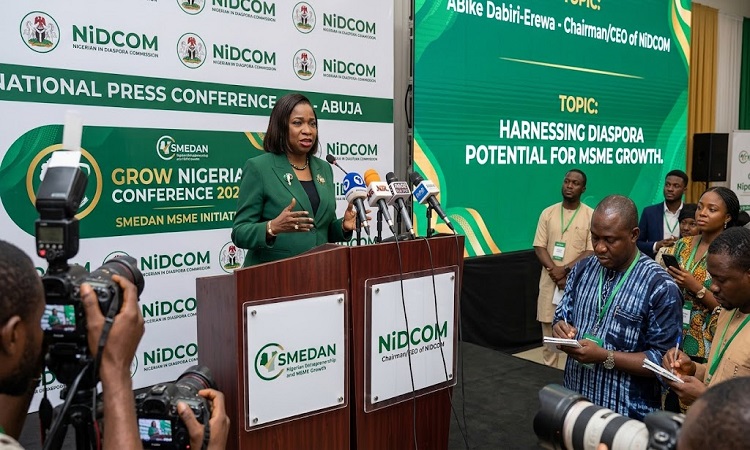
The Chairman and Chief Executive Officer of NiDCOM, Hon. Abike Dabiri-Erewa, disclosed this on Friday through the Acting Secretary of the Commission, Hon. Abdulrahman Terab, at a press conference in Abuja ahead of the 9th Nigeria Diaspora Investment Summit (NDIS) 2026.
Dabiri-Erewa said the summit, scheduled for November 10 and 11, would focus on addressing the challenges limiting diaspora investments in Nigeria — particularly the lack of trust, transparency and access to credible investment opportunities.
The summit, themed “Bridging the Trust Gap: Connecting Diaspora Capital with Credible Home-Based Opportunities,” is expected to bring together Nigerians in the diaspora, government institutions, financial regulators, investors, business owners and project developers to explore investment opportunities across critical sectors of the economy.
According to Dabiri-Erewa, Nigeria’s diaspora community possesses enormous financial, entrepreneurial, professional and intellectual resources that could significantly contribute to the country’s economic transformation if effectively mobilised. She described the diaspora as a major economic resource whose contributions must extend beyond remittances to direct investments in productive sectors of the economy.
“The Nigerian Diaspora Investment alone, if harnessed to its full potentials, can measure up to 100 billion Dollars every year as inflow into the Nigerian Economy,” she said.
She added that effectively utilising diaspora resources would support the Federal Government‘s ambition of building a $1 trillion economy.
Trust Deficit Identified as Major Barrier
The NiDCOM boss identified the lack of transparency, inadequate investor protection, unreliable information and weak institutional confidence as some of the challenges discouraging Nigerians abroad from investing in their home country.
She stressed that attracting diaspora capital requires more than presenting investment opportunities, noting that prospective investors must be assured of credible institutions, transparent processes, effective regulations and adequate protection for their investments.
“Unlocking the full potential of diaspora investment requires more than just showcasing opportunities. It demands transparency, robust investor protection, credible institutions, reliable information, and effective regulatory frameworks,” she said.
Dabiri-Erewa explained that the 2026 summit would provide a platform for prospective investors to engage directly with government institutions, regulators, investment agencies and project sponsors to obtain first-hand information on investment procedures, compliance requirements and available safeguards.
Capital Market, Infrastructure and Regulation in Focus
The two-day programme will feature three major thematic areas covering capital market opportunities, infrastructure investment and regulatory frameworks.
Day one (November 10) will focus on Nigeria’s capital market, with discussions covering available financial instruments, investment entry procedures, transparency measures, risk management and safeguards for diaspora investors. Institutions expected to participate include the Securities and Exchange Commission (SEC), Nigerian Exchange Group (NGX), Central Bank of Nigeria (CBN) and Ministry of Finance Incorporated (MOFI), alongside capital market operators and investment advisers.
📖 Related Reads
Day two (November 11) will concentrate on infrastructure opportunities and regulatory frameworks, including bankable infrastructure projects, public-private partnerships and investment opportunities designed to encourage diaspora participation. The Infrastructure Concession Regulatory Commission (ICRC), Nigerian Sovereign Investment Authority (NSIA), Corporate Affairs Commission (CAC) and other relevant agencies are expected to provide information on investment opportunities and regulatory requirements.
The afternoon session will further address business registration, due diligence, anti-fraud measures, consumer protection and ongoing reforms aimed at improving Nigeria’s business environment.
Dabiri-Erewa noted that the summit would move beyond general discussions on diaspora engagement by providing participants with opportunities to interact with regulators, mortgage providers, project sponsors and verified service providers through dedicated question-and-answer sessions.
Hybrid Format Announced
The 2026 edition will adopt a hybrid format, with virtual participation through Zoom and limited physical attendance at the Shehu Musa Yar’Adua Centre, Abuja. The physical component was deliberately scaled down because of the forthcoming national election campaign season, but the Commission assured Nigerians in the diaspora that its commitment to promoting safe and credible investment opportunities remained unchanged.
She described the 2026 summit as an important foundation for the 10th anniversary edition scheduled for 2027.
Connecting Capital to Credible Opportunities
Also speaking, the Coordinator of the Nigeria Diaspora Summit Initiative (NDSI), Mr Mobolaji Lewis, said the summit was designed to ensure that the financial and professional resources of Nigerians abroad were channelled into credible investment opportunities that would deliver measurable economic benefits.
Lewis noted that while the Nigerian diaspora had enormous resources capable of supporting national development, building confidence among prospective investors remained essential to unlocking their full potential.
“Our objective is not simply to attract the diaspora capital, but to ensure that such capital is connected to credible, transparent, and properly structured investment opportunities,” he said.
He explained that the Nigeria Diaspora Summit Initiative had worked closely with NiDCOM over the years to create platforms through which Nigerians living abroad could explore investment opportunities and participate more safely in the country’s economic development. According to him, the partnership was aimed at ensuring that diaspora investors had access to the necessary information and institutional support to make informed investment decisions.
Lewis expressed optimism that the summit would help convert diaspora confidence into productive investments and, ultimately, sustainable national development.
He urged Nigerians in the diaspora, business associations, professionals, institutional investors, entrepreneurs and project developers to participate in the two-day engagement.
The 9th Nigeria Diaspora Investment Summit is organised by NiDCOM in partnership with the Nigeria Diaspora Summit Initiative and other stakeholders, including First Bank of Nigeria Plc. The summit is expected to strengthen engagement between Nigerians abroad and home-based investment institutions while laying the groundwork for the 10th anniversary edition in 2027.