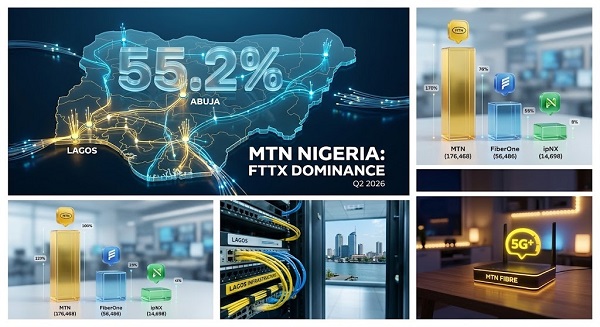
MTN Nigeria has solidified its lead in the country’s fibre broadband space, accounting for more than half of all Fibre to the X (FTTX) subscriptions in Q2 2026, according to new data from the Nigerian Communications Commission (NCC).
The latest industry figures show that MTN recorded 176,468 FTTX subscriptions during the period, representing 55.2% of the total 319,735 subscriptions across the market. This places the telecom giant far ahead of traditional internet service providers (ISPs), with its closest rival, FiberOne Broadband, trailing at just 56,486 subscriptions — a 17.7% market share.
NCC Data Highlights a Concentrated Market
The NCC’s fibre market report also reveals the following standings among other key players:
-
ipNX Nigeria – 14,698 subscriptions
-
Broadbased Communication – 10,761
-
Ngcom – 5,958
-
Airtel – 4,417
-
Luli Fibra Cables Solution – 4,412
-
Layer3 – 3,613
-
Choice2mobile Technology – 3,492
-
Legend Internet Plc – 3,101
-
Amdeetel Nigeria – 2,824
-
Swift Networks – 2,509
The data underscores a highly concentrated market: the top two operators — MTN and FiberOne — alone account for nearly 73% of all FTTX subscriptions in Nigeria.
The Long Tail of Smaller Providers
Beyond the market leaders, the fibre space remains fragmented, with dozens of smaller providers catering to niche subscriber bases. Notable mentions include:
-
Kkon Technologies – 2,289
-
Ciudad Infrastructure – 2,144
📖 Related Reads
-
MangoNet Integrated Technologies – 1,878
-
Dotmac Technologies – 1,690
-
Wow Networks – 1,641
-
Main One Cable Company Nigeria – 1,503
-
Spectranet – 1,344 (the largest ISP in Nigeria by overall customer base, but with a modest fibre footprint)
In total, the NCC tracked 100 operators, though the vast majority recorded subscriber numbers far below the industry leaders.
MTN’s FibreX Rebrand and National Broadband Ambitions
In a strategic move last year, MTN Nigeria rebranded its fibre service from MTN Fibre Broadband to FibreX, a name the company says reflects its commitment to accelerating Nigeria’s digital transformation.
The rebrand aligns with the National Broadband Plan (NBP) 2020–2025, which targets 70% broadband penetration by 2025, with minimum speeds of 25 Mbps in urban areas and 10 Mbps in rural regions.
MTN has also positioned FibreX as a key driver in expanding national fibre capacity from 35,000 km to 125,000 km, which involves laying an additional 90,000 km of fibre optic cable across the country.
Fibre Access Still Concentrated in Major Cities
Despite significant infrastructure expansion, fibre internet access remains heavily skewed toward urban centres.
According to the NCC, operators have deployed a total of 101,148.36 km of fibre optic cable across Nigeria’s 36 states and the Federal Capital Territory (FCT). However, nearly one-fifth of that infrastructure is concentrated in just two locations:
-
Lagos and the FCT together account for 18,559.83 km — or 18.35% — of the nation’s total fibre network.
This geographic imbalance highlights the ongoing challenge of extending high-speed internet to underserved and rural areas, even as fibre adoption surges in major cities.
Stay tuned to Techfalz.com for more updates on Nigeria’s telecom and digital infrastructure landscape.