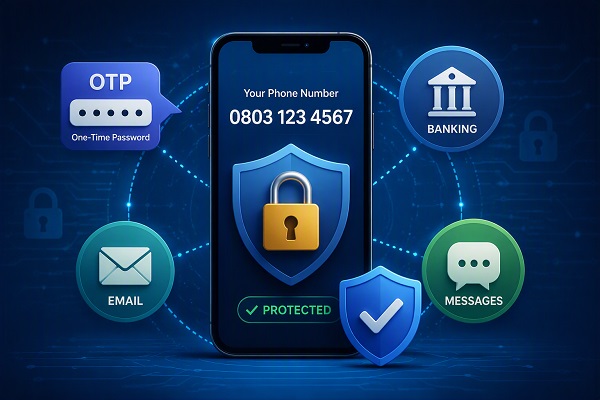
Your phone number may look like an ordinary string of digits, but it can be connected to your bank account, email address, WhatsApp account, social media profiles and other online services.
This is why criminals may target your mobile number through a scam known as SIM swap fraud.
SIM swap fraud occurs when someone tricks or manipulates a mobile network operator into transferring your phone number from your SIM card to another SIM card controlled by the fraudster. Once the transfer succeeds, the criminal may begin receiving calls, SMS messages and verification codes intended for you.
For Nigerian phone users, understanding how this scam works is important because a mobile number may be connected to financial and digital accounts.
ALSO READ: How to Check if a Smartphone Supports 5G
What Is SIM Swap Fraud?
A SIM swap is not necessarily fraudulent.
For example, if your SIM is lost, damaged or stolen, you may legitimately request a replacement SIM from your network provider while keeping the same phone number.
A fraudulent SIM swap, however, happens when someone obtains control of your number without your permission.
The criminal attempts to convince the mobile operator that they are the legitimate owner of the number and need the number transferred to another SIM.
The NCC has warned about fraudulent SIM replacement and emphasised compliance with SIM replacement procedures.
How Does SIM Swap Fraud Work?
The process generally involves several stages.
1. The Criminal Collects Information About You
The fraudster may first try to obtain personal information about the target.
This information could come from phishing, social engineering, publicly available information, data breaches or other sources.
The FBI has documented SIM-swap schemes involving social engineering and phishing, where criminals obtain information that can help them impersonate victims.
The important lesson is that information that appears harmless individually can become valuable when combined.
ALSO READ: How to Protect Your NIN From Identity Theft in Nigeria
2. The Criminal Pretends to Be You
The criminal then contacts the mobile network operator or attempts to initiate a SIM replacement through an available channel.
They may claim that their phone or SIM has been lost, stolen or damaged.
The goal is to persuade the provider that the person requesting the replacement is the legitimate subscriber.
3. Your Number Is Transferred
If the fraudulent request succeeds, the victim’s phone number is moved to a SIM card controlled by the criminal.
The legitimate SIM may then stop connecting to the mobile network.
The NCC describes a SIM swap as the transfer of a customer’s mobile number from one SIM card to another, while warning that unauthorised swaps can create significant security risks.
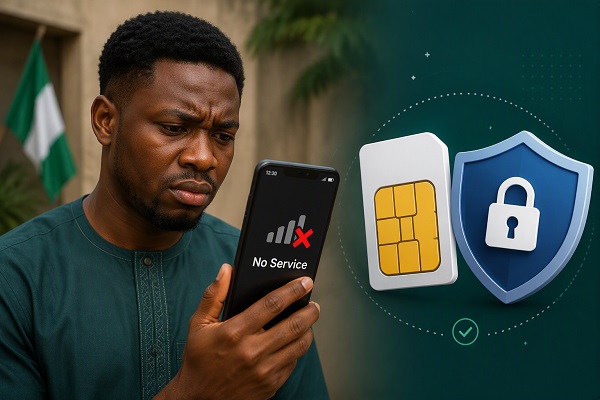
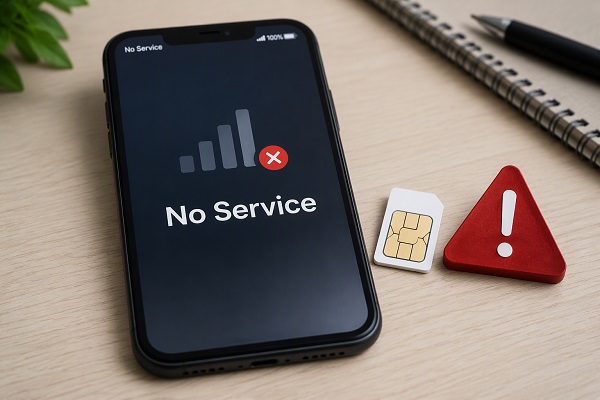
4. Your Phone May Suddenly Lose Network Service
One of the biggest warning signs can be an unexpected loss of mobile service.
Your phone may suddenly display:
No Service
or
Emergency Calls Only
If your SIM was working normally and suddenly loses network connectivity without an obvious explanation, do not automatically assume that the problem is a temporary network outage.
A SIM swap is one possibility that should be investigated.
5. The Criminal Receives Your SMS Codes
If the number has been successfully transferred, SMS messages sent to that number may reach the criminal’s SIM instead of yours.
This becomes particularly dangerous when online accounts use SMS-based verification.
The FBI explains that criminals who successfully take control of a number can potentially receive one-time passcodes and use account-recovery processes to gain access to associated accounts.
6. The Criminal May Attempt Account Takeover
After gaining control of the phone number, a fraudster may attempt to reset passwords or access accounts associated with the number.
Potential targets can include:
- Email accounts
- Social media accounts
- Financial accounts
- Cryptocurrency accounts
- Messaging accounts
- Online services
The exact risk depends on how each service authenticates users.
Why Is SIM Swap Fraud Dangerous?
The problem is not simply that someone has control of your SIM.
Your phone number may function as part of the security system for other accounts.
If an online service sends a verification code to your mobile number and a criminal controls that number, the criminal may receive the code.
This is why security experts generally recommend using stronger forms of multi-factor authentication where available instead of relying exclusively on SMS.
Warning Signs of a SIM Swap
Watch for several unusual events happening around the same time.
Sudden Loss of Mobile Service
Your phone unexpectedly stops receiving calls and SMS messages even though there is normally network coverage.
Unexpected SIM Notifications
You receive a message or notification about SIM replacement, activation or account changes that you did not request.
Unexpected Password Reset Messages
You receive password-reset or login notifications for accounts you did not attempt to access.
Bank or Financial Alerts You Did Not Initiate
Unexpected transaction or account-security notifications should be treated seriously.
WhatsApp Re-Registration Messages
If someone attempts to register your WhatsApp number on another device, you may receive verification-related messages.
📖 Related Reads
Do not share WhatsApp verification codes with anyone.
You Suddenly Stop Receiving OTPs
If verification codes that normally arrive by SMS suddenly stop arriving, investigate the problem instead of repeatedly requesting new codes.
How to Protect Yourself From SIM Swap Fraud
1. Protect Your Personal Information
Do not publish unnecessary personal information online.
Be careful about sharing information such as:
- Full date of birth
- Address
- Phone number
- Identification details
- Banking information
- Account recovery information
Criminals can combine different pieces of information to make impersonation attempts more convincing.
2. Never Share OTPs
A legitimate company should not require you to disclose a confidential one-time password to an unknown caller or agent.
The NCC has specifically warned Nigerian consumers about fake SIM-registration agents who may request OTPs during fraudulent SIM replacement schemes.
If someone calls claiming to be from your network provider and asks for an OTP, treat the request with extreme caution.
3. Use Strong Account Passwords
Do not reuse the same password across multiple important accounts.
Your email account deserves particular attention because it can sometimes be used to reset passwords for other services.
Use unique, strong passwords for important accounts.
4. Use an Authenticator App Where Available
Where an online service offers an authenticator app or security key instead of SMS verification, consider using it.
This can reduce your dependence on your mobile number for authentication.
SMS verification can still be useful, but it should not necessarily be your only security layer for highly sensitive accounts.
5. Secure Your Email Account
Your email account is particularly important because it may provide access to password-reset links and security notifications.
Enable strong authentication and review your account’s recovery options and signed-in devices regularly.
6. Contact Your Network Immediately If Your SIM Stops Working Unexpectedly
If your phone suddenly loses network service and you have ruled out a normal network problem, contact your mobile network operator through its official customer-service channels.
Ask whether there has been a SIM replacement or other change involving your number.
Do not rely on a phone number supplied by a suspicious caller or message.
7. Contact Your Bank If You Suspect Account Compromise
If you suspect that someone has taken control of your number and your banking services are connected to it, contact your bank immediately using an official channel.
Ask the bank to secure your account and investigate any unauthorised activity.
Speed matters because the attacker may attempt to use account-recovery mechanisms after taking control of your number.
8. Secure Your Other Online Accounts
Change passwords for important accounts if you believe your phone number has been compromised.
Start with your:
- Banking and financial services
- Social media
- WhatsApp and other messaging accounts
- Cryptocurrency accounts
- Other accounts using the affected number
What Is Nigeria’s TIRMS and How Does It Help?
The Nigerian Communications Commission introduced the Telecommunications Identity Risk Management System (TIRMS) to help authorised organisations verify the status of mobile numbers.
According to the NCC’s August 2026 explanation, TIRMS can help authorised service providers identify whether a number has been swapped, churned, or reassigned. Banks and fintech companies can use the system to verify number status where appropriate, including before certain sensitive activities.
This is important because mobile numbers are increasingly connected to financial and digital services.
TIRMS does not mean individual users no longer need to protect their information. Consumers should continue to follow safe account and SIM-security practices.
What Should You Do If You Think You Are a Victim?
Act quickly.
Step 1: Contact your mobile network operator through an official channel.
Step 2: Ask whether an unauthorised SIM replacement or related change occurred.
Step 3: Contact your bank or financial service provider if the number is linked to financial accounts.
Step 4: Secure your email account.
Step 5: Change passwords for important accounts.
Step 6: Check recent account activity for transactions or logins you do not recognise.
Step 7: Secure your WhatsApp and other messaging accounts.
Step 8: Report suspected fraud to the appropriate authorities or service provider.
Keep records of relevant messages, transaction alerts and communications because they may be useful when reporting the incident.
Final Thoughts
SIM swap fraud works by exploiting the connection between your mobile number and your online identity.
A criminal does not necessarily need to steal your physical phone. If they can persuade a mobile provider to transfer your number to a SIM they control, they may be able to intercept calls and SMS-based verification codes and then attempt to compromise other accounts.
For Nigerian users, the safest approach is to protect personal information, avoid sharing OTPs, use stronger authentication methods where available, monitor unexpected account activity and respond quickly if your SIM suddenly stops working.
Your phone number is more than a way to make calls. Treat it as an important part of your digital identity.