Students can use ChatGPT to support learning, understand difficult topics, organise study materials and prepare for examinations. However, the quality of the response often depends on how clearly the question or instruction is written.
This is where ChatGPT prompts become useful.
A prompt is simply the instruction or question you give to ChatGPT. Instead of typing something vague such as “Explain mathematics,” a student can provide more information about the topic, academic level, learning objective and preferred format.
ALSO READ: How to Use AI to Turn Your Class Notes Into Revision Questions
For example, instead of asking:
“Explain photosynthesis.”
You could write:
“Explain photosynthesis to a secondary school student using simple language. Break the explanation into five steps and give one everyday example.”
The second prompt gives ChatGPT more context, making the response more useful for learning.
Below are some of the best ChatGPT prompts students can use for studying, research, assignments, revision and exam preparation.
1. Prompt for Understanding a Difficult Topic
When you do not understand something taught in class, ask ChatGPT to explain it at your level.
Prompt:
“Explain [TOPIC] to me as a [JSS/SS/undergraduate] student. Use simple language, break the topic into smaller sections, and give practical examples.”
This is particularly useful when a textbook explanation is too technical.
2. Prompt to Explain a Topic Like a Teacher
You can ask ChatGPT to act as a tutor rather than simply providing a short definition.
Prompt:
“Act as my personal tutor. Teach me [TOPIC] step by step. Start with the basic concepts, then gradually introduce the more difficult parts. After each section, ask me a short question to test my understanding.”
This can turn ChatGPT into an interactive study assistant.
3. Prompt for Revision Notes
Instead of rereading a long chapter repeatedly, use a prompt to organise the information into revision notes.
Prompt:
“Turn the following study material into clear revision notes. Keep the important definitions, concepts, formulas, examples and key points. Use headings and bullet points. Do not remove information that is important for an examination.”
Students should still compare the generated notes with their original textbook or class material.
4. Prompt to Summarise Class Notes
If you have lengthy notes, ChatGPT can help organise them.
Prompt:
“Summarise these class notes for revision. Identify the main ideas, important definitions, key facts and examples. Use simple language and organise the information under clear headings.”
Paste your notes after the prompt.
5. Prompt to Generate Practice Questions
Practice questions can help you identify areas you have not mastered.
Prompt:
“Create 20 practice questions on [TOPIC] for a [JSS/SS/university] student. Mix multiple-choice, short-answer and theory questions. Do not provide the answers yet.”
You can answer the questions yourself before asking ChatGPT to mark them.
6. Prompt for Multiple-Choice Questions
Students preparing for objective examinations can use:
Prompt:
“Create 30 multiple-choice questions on [TOPIC]. Provide four options labelled A, B, C and D. Make the questions similar in difficulty to a school examination. Put the answer key at the end.”
For Nigerian students, you can further specify the examination style you are preparing for, such as school examinations, JAMB-style practice or WAEC-style revision, while avoiding presenting AI-generated questions as official past questions.
7. Prompt for Exam Revision
Use this prompt when preparing for an upcoming examination.
Prompt:
“I have an examination on [SUBJECT] in [NUMBER] days. Create a revision plan covering these topics: [LIST TOPICS]. Give me a realistic daily study schedule, including revision, practice questions and review sessions.”
This can help turn a large syllabus into manageable study sessions.
8. Prompt to Identify Weak Areas
After completing practice questions, ask ChatGPT to analyse your mistakes.
Prompt:
“Here are my answers to these practice questions. Identify the topics I performed poorly on, explain my mistakes, and recommend what I should revise before attempting another test.”
This is more useful than simply asking for the correct answers.
9. Prompt for a Step-by-Step Mathematics Solution
For mathematics, students should ask for explanations rather than only answers.
Prompt:
“Solve this mathematics problem step by step. Explain why each step is necessary, show the formula used, and give me a similar problem to solve myself afterward.”
This encourages understanding of the method.
10. Prompt to Check Your Mathematics Answer
If you have already attempted a problem, use:
Prompt:
“I attempted this mathematics problem myself. Check my working step by step. Do not immediately give me the answer. Identify where my method first went wrong and explain how I can correct it.”
This can help students learn from mistakes.
ALSO READ: How to Avoid Plagiarism When Using Online Sources for Assignments
11. Prompt for Science Revision
Prompt:
“Teach me [SCIENCE TOPIC] at secondary-school level. Explain the important concepts, definitions, processes and examples. Then give me 10 questions to test my understanding.”
This can be useful for subjects such as Biology, Chemistry, Physics and Basic Science.
12. Prompt for Essay Writing Practice
Students can practise writing essays without asking AI to produce the final submission.
Prompt:
“Give me an essay question on [TOPIC]. Provide an outline showing how I could structure the introduction, main points and conclusion. Do not write the complete essay for me.”
This encourages the student to develop their own writing skills.
13. Prompt to Improve Your Writing
After writing your own essay, you can use ChatGPT as an editor.
Prompt:
“Review my essay for grammar, spelling, clarity, sentence structure and organisation. Identify areas that need improvement and explain why. Preserve my ideas and do not rewrite the entire essay.”
This is useful for learning from writing mistakes.
14. Prompt for Vocabulary Development
Prompt:
“Give me 15 useful academic vocabulary words related to [SUBJECT/TOPIC]. For each word, provide a simple definition and an example sentence.”
Students can then practise using the words in their own writing.
15. Prompt to Create Flashcards
Prompt:
“Turn these notes into 25 study flashcards. Put one question on the front and a concise answer on the back. Focus on important definitions, facts, concepts and formulas.”
Flashcards can be particularly useful for memorisation and quick revision.
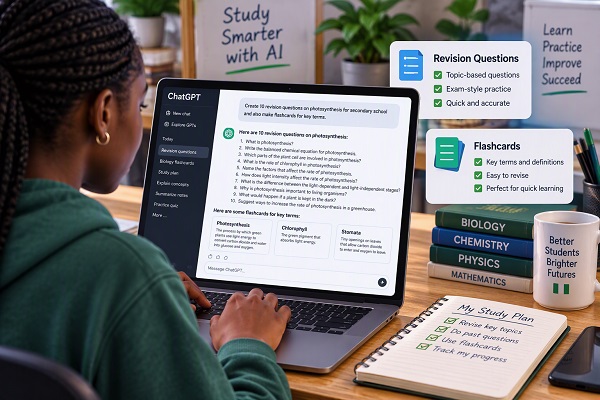
16. Prompt to Turn Notes Into Questions
This is one of the easiest ways to make passive reading more active.
📖 Related Reads
Prompt:
“Read these notes and create 20 revision questions from them. Include easy, medium and difficult questions. Do not show the answers until I ask for them.”
After attempting the questions, ask ChatGPT to mark your responses.
17. Prompt for a Study Quiz
Prompt:
“Give me a 10-question quiz on [TOPIC], one question at a time. Wait for my answer before giving me the next question. At the end, calculate my score and explain the questions I got wrong.”
This creates a more interactive revision session.
18. Prompt to Explain a Wrong Answer
When you get something wrong, do not simply memorise the correct answer.
Prompt:
“I answered [ANSWER], but the correct answer is [CORRECT ANSWER]. Explain why my answer is wrong, why the correct answer is right, and give me one similar question to practise.”
19. Prompt for Research Ideas
Students working on projects can ask ChatGPT for possible research directions.
Prompt:
“Suggest 10 research topics about [SUBJECT]. For each topic, explain the main issue it could investigate and suggest possible research questions.”
Students should independently verify information and use credible academic sources before including factual claims in their work.
ALSO READ: How to Create Digital Flashcards for Exam Revision
20. Prompt to Find Gaps in an Assignment
After writing an assignment, try:
Prompt:
“Review my assignment against this question: [ASSIGNMENT QUESTION]. Identify important parts of the question that my answer has not addressed. Do not rewrite the assignment.”
This can help students notice missing sections.
21. Prompt for Presentation Preparation
Prompt:
“Help me prepare a 10-minute classroom presentation about [TOPIC]. Create an outline with an introduction, five main points, examples and a conclusion. Suggest questions my teacher or classmates might ask.”
The student should then prepare and practise the presentation themselves.
22. Prompt for Presentation Slides
Prompt:
“Create a slide-by-slide outline for a school presentation on [TOPIC]. Limit it to 10 slides. Give each slide a short title and three to five key points. Do not overload the slides with text.”
23. Prompt for Learning a New Subject
Prompt:
“I am new to [SUBJECT]. Create a beginner-friendly learning roadmap that starts with the fundamentals and progresses to intermediate topics. Explain what I should learn first and what I should study next.”
This can help students create a structured learning path.
24. Prompt for Daily Study Planning
Prompt:
“Create a study timetable for me. I need to study [SUBJECTS]. I have [NUMBER] hours available each day and my examination is on [DATE]. Include breaks, revision, practice questions and time for difficult subjects.”
A realistic timetable should account for sleep, school, meals and other responsibilities.
25. Prompt to Learn From a Textbook
Prompt:
“I am studying the following textbook section. Explain the difficult parts in simple language, identify the most important concepts, and give me five questions I should be able to answer after studying it.”
This can make difficult reading more manageable.
26. Prompt for JAMB-Style Practice
Students preparing for JAMB can use a prompt such as:
Prompt:
“Create 20 original practice questions on [TOPIC] at a level appropriate for JAMB preparation. Use four options: A, B, C and D. Do not claim that these are official JAMB past questions. Provide the answers and explanations after the questions.”
AI-generated practice questions should not be confused with authentic examination questions.
27. Prompt for WAEC-Style Practice
Prompt:
“Create original examination practice questions on [TOPIC] suitable for a secondary-school student preparing for WAEC. Include both objective and theory questions. Do not present them as official WAEC past questions.”
This distinction is important because students should use genuine past questions and official examination materials where authenticity matters.
28. Prompt for Learning From Mistakes
One of the most effective uses of ChatGPT is reviewing mistakes.
Prompt:
“Here are five questions I got wrong. For each one, explain the concept I misunderstood, show the correct reasoning, and give me one new question that tests the same concept.”
This turns mistakes into additional learning opportunities.
29. Prompt to Create a Mock Examination
Prompt:
“Create a 40-question mock examination on [SUBJECT]. Cover the major topics in this syllabus: [LIST TOPICS]. Include different difficulty levels. Give me the questions first and wait until I finish before providing the marking guide.”
You can then complete the test under timed conditions.
30. Prompt to Become an Active Learner
Finally, students can ask ChatGPT to avoid simply giving them answers.
Prompt:
“Act as my study tutor. Do not immediately give me answers to academic questions. First ask what I already understand, give me hints when appropriate, and guide me toward the answer. Explain the concept after I have attempted the problem.”
This approach can make AI more useful as a learning tool rather than simply an answer generator.
How to Write Better ChatGPT Prompts as a Student
The best prompts usually contain several useful pieces of information.
Tell ChatGPT your level
Instead of saying:
“Explain economics.”
Say:
“Explain inflation to a secondary-school student.”
Give it the topic
Be specific about what you want to learn.
Tell it the format you want
You can request:
- Bullet points
- Tables
- Flashcards
- Multiple-choice questions
- Step-by-step explanations
- Examples
- Revision notes
- Quizzes
Tell it what not to do
For example:
“Do not give me the answer immediately. Give me a hint first.”
Provide relevant material
When working from class notes or a textbook section, provide the actual material so the response can be based on the information you are studying.
Should Students Use ChatGPT for Assignments?
ChatGPT can be useful for brainstorming, explaining concepts, creating practice questions, reviewing drafts and helping students understand difficult material.
However, students should follow their school’s or institution’s rules about AI use.
Do not automatically submit AI-generated work as your own. If an assignment requires independent work, use ChatGPT as a learning assistant rather than a replacement for your own thinking.
Students should also verify important information because AI systems can sometimes produce incorrect or outdated answers.
Final Thoughts
The best ChatGPT prompts for students are not necessarily the longest ones. They are prompts that clearly explain what the student wants to learn, their academic level and the type of response they need.
Instead of using ChatGPT only to get answers, students can use it to practise questions, explain difficult concepts, review mistakes, create revision materials and test their understanding.
The goal should be to use AI to learn better, not simply to do the learning for you.
Save the prompts in this guide and adapt the words in brackets to your subject, class level and learning needs.