
Artificial intelligence has changed the way bloggers research topics, write articles, create images, edit content and promote their websites.
For Nigerian bloggers, AI tools can be particularly useful when working with limited time, small editorial teams or a one-person blog. Instead of spending hours starting an article from scratch, a blogger can use AI to brainstorm ideas, organise research, create an outline, improve writing and prepare social media content.
However, AI should be treated as a content assistant, not a replacement for the blogger.
Google’s current Search guidance makes an important distinction: using AI is not automatically a problem, but generating large amounts of unoriginal content primarily to manipulate search rankings can fall under its scaled content abuse policy.
With that in mind, here are some of the most useful AI tools Nigerian bloggers can consider in 2026.
1. ChatGPT – For Content Planning, Writing and Editing
OpenAI’s ChatGPT is one of the most versatile tools available to bloggers.
A blogger can use it to:
- Generate article ideas
- Create article outlines
- Develop headlines
- Rewrite difficult paragraphs
- Simplify technical explanations
- Create FAQs
- Brainstorm social media posts
- Create video scripts
- Improve grammar and readability
- Analyse supplied documents
- Repurpose an article into different formats
For a Nigerian blog, the quality of the result depends heavily on the instructions provided.
Instead of asking:
“Write an article about Nigerian students.”
Give the AI more context, such as the intended audience, Nigerian location, publication style, article length, keywords and sources that should be consulted.
This produces a more useful starting point for editorial work.
2. Google Gemini – Useful for Research and Google-Centred Workflows
Google’s Gemini can be useful for bloggers who already work heavily with Google’s ecosystem.
Bloggers can use AI assistants such as Gemini for:
- Topic research
- Brainstorming
- Summarising information
- Drafting content
- Comparing ideas
- Working with documents
- Creating outlines
- Developing content plans
It can be particularly convenient for bloggers who use services such as Google Docs and other Google products as part of their workflow.
However, important facts should still be checked against authoritative sources before publication.
3. Claude – Useful for Long-Form Drafting and Editing
Anthropic’s Claude is another option for bloggers who work with long documents and detailed writing instructions.
It can help with:
- Long-form article planning
- Editing
- Rewriting
- Summarising documents
- Developing article structures
- Creating content briefs
- Improving consistency across long pieces of writing
For bloggers who already have research notes, interviews or source documents, an AI assistant can help organise the information into a clearer structure.
The final article should still be checked by a human before publication.
4. Perplexity – For Research and Finding Sources
Perplexity can be useful during the research stage of blogging.
Rather than immediately asking an AI to write an entire article, a blogger can first use a research-oriented tool to investigate:
- Recent developments
- Official announcements
- Product specifications
- Government information
- Technology updates
- Industry statistics
- Background information
This can be particularly useful when writing about Nigerian government programmes, education, technology, banking, telecommunications or other subjects where information changes frequently.
However, bloggers should open and check the original sources rather than relying entirely on an AI-generated summary.
5. Canva AI – For Blog Graphics and Social Media Images
Canva is useful when a blogger needs both design and content-creation capabilities.
Canva’s AI-powered features can help create:
- Featured images
- Social media graphics
- Infographics
- YouTube thumbnails
- Presentation graphics
- Promotional designs
- Simple visual explanations
For a Nigerian news or technology blog, this can make it easier to create consistent visual branding without requiring advanced graphic-design skills.
A good workflow is to create a blog article first and then design supporting graphics that communicate the article’s main idea.
6. Grammarly – For Editing and Proofreading
Grammarly is best viewed as an editing tool rather than a complete blogging system.
It can help identify problems involving:
- Grammar
- Spelling
- Sentence structure
- Clarity
- Tone
- Wordiness
- Readability
This can be useful when a blogger has written an article personally but wants another layer of editing before publication.
Nigerian bloggers should still review suggested changes manually because automated writing suggestions may sometimes alter local expressions, names or intended meaning.
7. Microsoft Copilot – For Everyday Content Tasks
Microsoft Copilot can assist with everyday writing and productivity tasks.
Bloggers can use an AI assistant in the Microsoft ecosystem to brainstorm topics, summarise information, draft text and work with documents.
It can be useful for bloggers who already use Microsoft products as part of their content-production workflow.
8. AI Image Generators – For Original Blog Visuals
AI image-generation tools can help bloggers create custom illustrations instead of relying exclusively on generic stock photographs.
For example, a technology blogger could create an illustration showing:
- A smartphone security concept
- An AI-powered classroom
- Cloud storage
- Cybersecurity
- A Nigerian student using technology
- A futuristic Nigerian technology scene
However, bloggers should be careful when creating images that appear to depict real people, events or official announcements.
An AI-generated illustration should not be presented as an authentic photograph of a real event.
9. AI Tools for SEO and Content Optimisation
There are also specialised AI-powered SEO platforms that can help bloggers analyse keywords, content structure and search intent.
These tools can assist with:
- Keyword research
- Content briefs
- Topic clusters
- Heading structures
- Search intent
- Internal linking ideas
- Content optimisation
However, bloggers should not write solely to satisfy an SEO score.
Google’s guidance emphasises creating useful, original content for people rather than producing pages primarily to manipulate search rankings.
10. AI Tools for Turning Articles Into Social Media Content
One article can be transformed into several pieces of content.
AI can help turn a published blog post into:
📖 Related Reads
- Facebook posts
- X posts
- LinkedIn posts
- WhatsApp Channel updates
- Short video scripts
- Instagram captions
- Newsletter summaries
This can save time for bloggers who manage several social media platforms.
The important thing is to adapt the content to each platform rather than posting exactly the same text everywhere.
ALSO READ: Blogger vs WordPress: Which Is Better for a New Website in 2026?
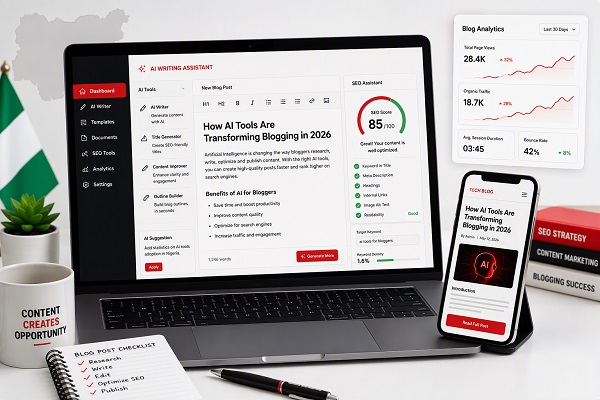
How Nigerian Bloggers Can Build an AI Content Workflow
Instead of using one AI tool for everything, bloggers can create a simple workflow.
Step 1: Find a useful topic
Start with questions people actually want answered.
For example:
How to Check if an Android App Is Safe Before Installing It
is more useful than simply producing another generic article titled:
Amazing Android Tips You Need to Know.
Step 2: Research the topic
Use Google Search, official websites, government sources, company documentation and reputable publications.
AI can help organise the information, but important facts should be verified against the original source.
Step 3: Create an outline
Use ChatGPT, Gemini or Claude to organise the research into a logical structure.
Step 4: Write the first draft
AI can help create a starting draft, but the blogger should add original explanations, examples, experiences, comparisons and useful Nigerian context.
Step 5: Fact-check everything
This is particularly important for articles involving:
- Government programmes
- Education
- Banking
- Loans
- Cryptocurrency
- Health
- Prices
- Product specifications
- Laws and regulations
Do not publish an AI-generated claim simply because it sounds convincing.
Step 6: Add original value
This is one of the most important steps.
Add information such as:
- Your own testing
- Screenshots
- Original photographs
- Nigerian examples
- Personal observations
- Expert comments
- Original comparisons
- Step-by-step instructions
Google’s publisher guidance says copied or automatically generated content without meaningful additional value can violate its policies, and AdSense expects publishers to provide unique and relevant content.
Step 7: Edit the article
Use an editing tool if necessary, but read the complete article yourself.
Remove repetitive sentences, unsupported claims and unnecessary AI-style wording.
Step 8: Create original visuals
Use Canva or an image-generation tool to create suitable graphics where appropriate.
Make sure the images actually represent the subject of the article.
Step 9: Optimise the article for Search
Add:
- A clear title
- Descriptive headings
- Relevant keywords
- Internal links
- Appropriate external sources
- Useful meta description
- Descriptive image alt text
Avoid stuffing keywords into every paragraph.
Step 10: Publish only after human review
The final responsibility belongs to the publisher.
AI should make the blogging process faster and more organised, but the blogger remains responsible for accuracy, originality and usefulness.
Best AI Tool by Blogging Task
| Blogging task | Useful AI option |
|---|---|
| Article ideas | ChatGPT / Gemini |
| Article outlines | ChatGPT / Claude |
| Long-form drafting | ChatGPT / Claude |
| Research assistance | Perplexity / Gemini |
| Editing | Grammarly / ChatGPT |
| Blog graphics | Canva |
| AI-generated illustrations | AI image generators |
| SEO planning | AI-powered SEO platforms |
| Social media content | ChatGPT / Canva |
| Content repurposing | ChatGPT / Gemini |
This table is a practical workflow guide rather than a claim that one tool is objectively superior in every situation.
Are AI-Written Articles Good for AdSense?
Using AI does not automatically make a website unsuitable for AdSense.
The more important issue is whether the website provides original, useful and policy-compliant content.
Google says AdSense publishers should create unique and relevant content, while its Search spam policies specifically warn against generating large numbers of pages with AI or other systems without adding value for users.
Therefore, Nigerian bloggers preparing for AdSense should avoid a workflow where they simply:
- Ask AI for 100 articles.
- Copy the answers.
- Add keywords.
- Publish everything automatically.
A better approach is:
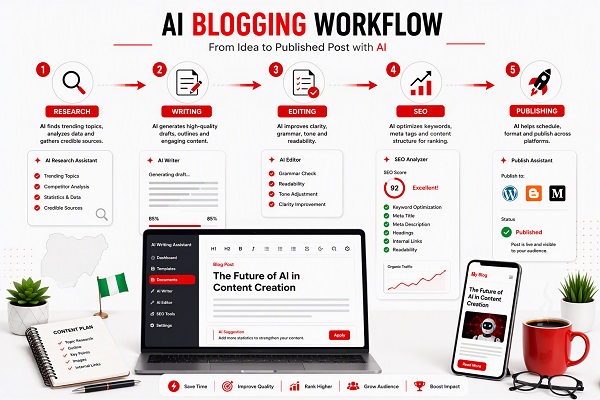
Research → AI assistance → Human writing/editing → Fact-checking → Original value → Visuals → SEO → Publication
Final Thoughts
AI tools can make blogging considerably easier in 2026.
A Nigerian blogger can use AI to generate ideas, research subjects, create outlines, improve writing, produce graphics and repurpose published articles for social media.
But the strongest workflow is not AI instead of the blogger.
It is AI plus human expertise.
For a small Nigerian blog, starting with a general-purpose AI assistant, a research tool, an editing tool and a design platform may be enough. There is no need to subscribe to every AI service available.
The key is to use each tool for the task it handles well while ensuring that the final article contains accurate information, original value and a clear reason for readers to visit your website.
For bloggers targeting Google Search and AdSense, this distinction is particularly important: Google’s current policies focus on the value and originality of published content rather than simply whether AI was involved in producing it.